- por James Roberts
Polycarbonate vs. Silicone Chocolate Molds: Which Material Is Right for Your Production?
- por James Roberts
If you're producing chocolate at any scale, the mold material you choose affects everything: the finish on your final product, your throughput, your per-unit costs, and how long your tooling lasts. In this comparison, we put our polycarbonate chocolate molds side by side with generic thin-silicone chocolate molds; the kind widely available on Amazon and similar retailers, so you can make a confident decision based on your production needs.

| Dimension | Polycarbonate (Bold Maker) | Silicone |
|---|---|---|
| Surface finish | Mirror-like, high-gloss | Matte or dull |
| Durability | 8-10 years in commercial use | 18-24 months in commercial use |
| Production compatibility | Automated and semi-automated lines | Manual production only |
| Temperature range | Up to approximately 120°C (248°F) | -40°C to +250°C |
| Demolding complex shapes | Limited by rigid structure | Excellent for deep undercuts and 3D shapes |
| Visual inspection | Transparent - inspect through the mold | Opaque - no visual inspection |
| Tempering requirement | Properly tempered chocolate required | Works with untempered chocolate |
| Food safety | FDA compliant | FDA compliant |
| Selection | Large off-the-shelf range, plus custom design capability | Limited designs, mostly consumer-grade |

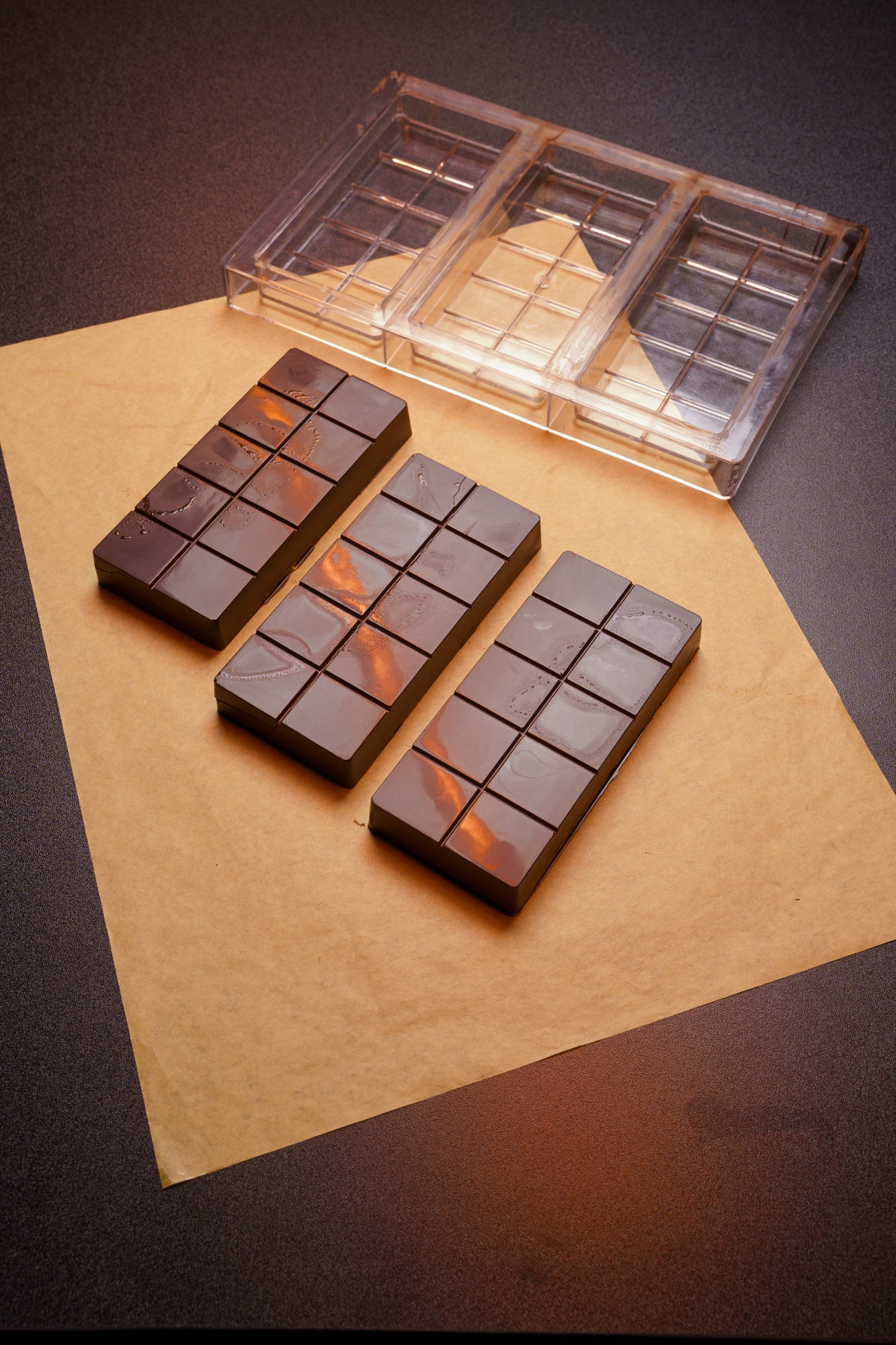
This is the dimension that matters most to anyone selling a premium chocolate product. Polycarbonate molds produce a mirror-like, high-gloss finish because of a straightforward physical process: when properly tempered chocolate (Form V crystals) cools inside a rigid, polished cavity, it contracts slightly and pulls away from the mold surface. That contraction-release mechanism transfers the polished interior of the mold directly onto the chocolate, creating the signature snap and shine that consumers associate with quality.
Silicone cannot replicate this. Because the material is flexible, it deforms around the chocolate as it cools instead of allowing the clean release that produces gloss. The result is a matte or dull surface. If you are producing bonbons, pralines, bars, or filled chocolates for retail or wholesale, that finish difference is immediately visible to your customer and directly impacts perceived value.

Polycarbonate molds last 8 to 10 years in commercial production environments. Thin Silicone molds, by contrast, typically need replacement every 18 to 24 months under regular commercial use. The flexible material degrades, tears, and loses dimensional accuracy over time.
The upfront cost of a polycarbonate mold is often comparable to, or modestly higher than, a silicone alternative. But when you factor in replacement frequency, polycarbonate delivers a significantly lower cost per mold-year. For a production operation running daily, that math adds up fast.

Polycarbonate's rigid structure keeps every cavity dimensionally stable during filling, vibration to remove air bubbles, scraping to level off excess chocolate, and conveying between stations. This makes polycarbonate molds compatible with automated and semi-automated production lines, which is why they are the professional industry standard worldwide for bonbons, bars, and pralines.
Thin Silicone molds flex under their own weight when loaded, making them difficult to convey, stack, or integrate into any mechanized workflow (not to be confused with thick, depositor capable platinum silicone molds that are designed and made for industrial-level production). They are best suited for hand-production environments where each mold is individually handled.

Silicone handles a much wider temperature range, from -40°C up to +250°C. That makes it usable in freezers and ovens, which is relevant if you work with frozen desserts, baked goods, or other applications beyond chocolate.
Polycarbonate tops out at approximately 120°C (248°F). For tempered chocolate work, which typically happens between 27°C and 32°C, and even hot sugar applications, that ceiling is more than adequate. But if you need a mold that moves between a blast freezer and a warm oven, silicone is the only option.

Silicone's flexibility is a genuine advantage when you need deep undercuts, unusual 3D geometries, or shapes that would make demolding from a rigid mold impossible. Think spheres with narrow openings, highly detailed figurines, or novelty shapes with overhangs. You simply peel the silicone away from the finished piece.
Polycarbonate molds require the chocolate (tempered) to release cleanly from a rigid cavity, which limits geometry to shapes that can be pulled straight out. That said, the vast majority of professional chocolate formats; bars, tablets, bonbons, cups, squares, hearts, and specialty shapes such as cannabis leaves, are well within polycarbonate's design range. Our collection alone spans everything from 0.45 mL heart cavities to 120 mL Dubai-style chocolate bar molds.

Polycarbonate is transparent. You can look through the mold to check fill levels, spot air bubbles, and verify that the chocolate has contracted properly before demolding. This is a small but meaningful production advantage, especially when training new team members or dialing in a new recipe.
Silicone molds are opaque. You are working blind until you demold.

Polycarbonate molds demand properly tempered chocolate. If your tempering is off, the chocolate will look matte, defeating the purpose, and may stick in the cavities. This is not a flaw in the mold; it is a feature of the process. The mold rewards good technique with a flawless result.
Silicone is more forgiving. It works with untempered chocolate and releases easily regardless of crystal structure. For hobbyists, beginners, or applications where gloss is not important, that forgiveness is helpful.

Our polycarbonate molds are FDA compliant, engineered for repeated commercial use with chocolate, hot sugar, and filling ingredients. Silicone molds that meet FDA 21 CFR 177.2600 are also food-safe for repeated food contact. The key difference is sourcing: not every silicone mold on the market carries proper certification. When buying silicone, verify the manufacturer's compliance documentation.

We carry the largest selection of premium off-the-shelf polycarbonate molds in the industry, covering cannabis edibles, peanut butter cups, multi-dose squares, hearts, bars, and dozens of other formats. Beyond the catalog, our award-winning engineering team (White Label World Expo Manufacturer of the Year, 2023) designs custom polycarbonate and silicone molds for brands that need a proprietary shape or cavity layout.
Generic silicone molds available through Amazon and similar retailers offer a range of designs, but are mostly oriented toward home bakers and hobbyists.
Choose polycarbonate if you are producing chocolate for sale. The high-gloss finish, multi-year durability, dimensional stability on production lines, and transparent inspection capability make polycarbonate the professional standard for a reason. If you are making bonbons, bars, pralines, filled chocolates, edibles, or peanut butter cups, and your product's appearance matters to your brand, polycarbonate is the right call. Our collection covers a wide range of formats and cavity sizes, and if you need something custom, we build that too.
Choose silicone if you are a hobbyist, or are producing alternative treats. Silicone is the better tool for frozen desserts, oven-based applications, or novelty geometries with deep undercuts. It is also a reasonable starting point for hobbyists who are still learning to temper chocolate and want a forgiving mold to practice with.
For most professional and semi-professional chocolate makers, polycarbonate is the investment that pays for itself many times over in product quality, mold longevity, and production efficiency. If you have questions about which mold fits your specific product, reach out to our team. We have been helping confectioners make these decisions for over a decade, and we are happy to walk you through it.
Con más de una década de experiencia en el sector, somos líderes en la fabricación de moldes con especialización en los mercados convencionales de dulces, chocolate y cannabis.
Como expertos probados, diseñamos y desarrollamos soluciones para algunos de los mayores confiteros y proveedores del planeta.
Si busca crear un producto que supere las expectativas, ¡contáctenos hoy mismo para comenzar!