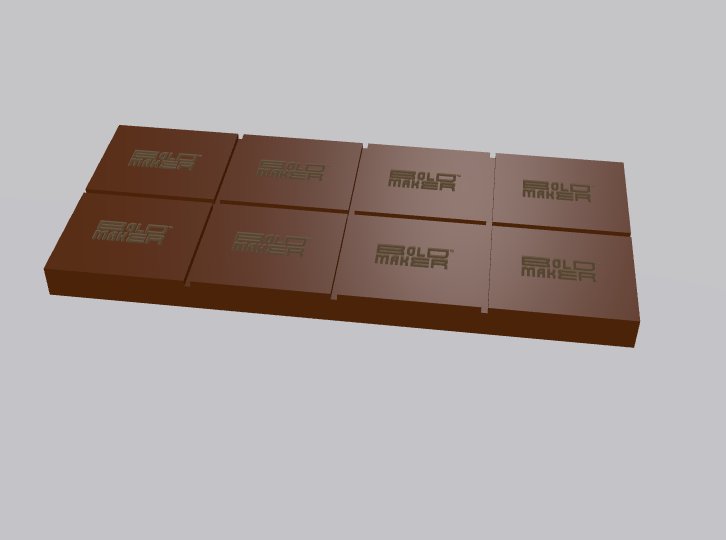

Most confectionery plant managers can tell you the exact cost of a rejected batch. Fewer can tell you what their mold wall thickness is, whether their mold material has been independently tested for food contact, or how many production cycles their current molds will survive before dimensional drift affects dosing accuracy. At Bold Maker, we have spent more than a decade engineering polycarbonate molds for the US confectionery industry, and the pattern we see is consistent; the mold is often the last thing a production team evaluates, and the first thing that causes problems on the line.
This article breaks down what matters when choosing food-grade polycarbonate molds for precision dosing in chocolate and candy plants, covering material science, regulatory compliance, cavity engineering and long-term cost of ownership.

Precision dosing in confectionery manufacturing depends on dimensional consistency across every cavity in every mold, pour after pour, shift after shift. When a mold warps, shrinks, or loses its surface finish, cavity volumes change. Even a small deviation in volume - fractions of a milliliter, can throw off target weights and active-ingredient dosing, particularly in regulated product categories where portion control determines compliance.
Not every polycarbonate formulation performs the same way
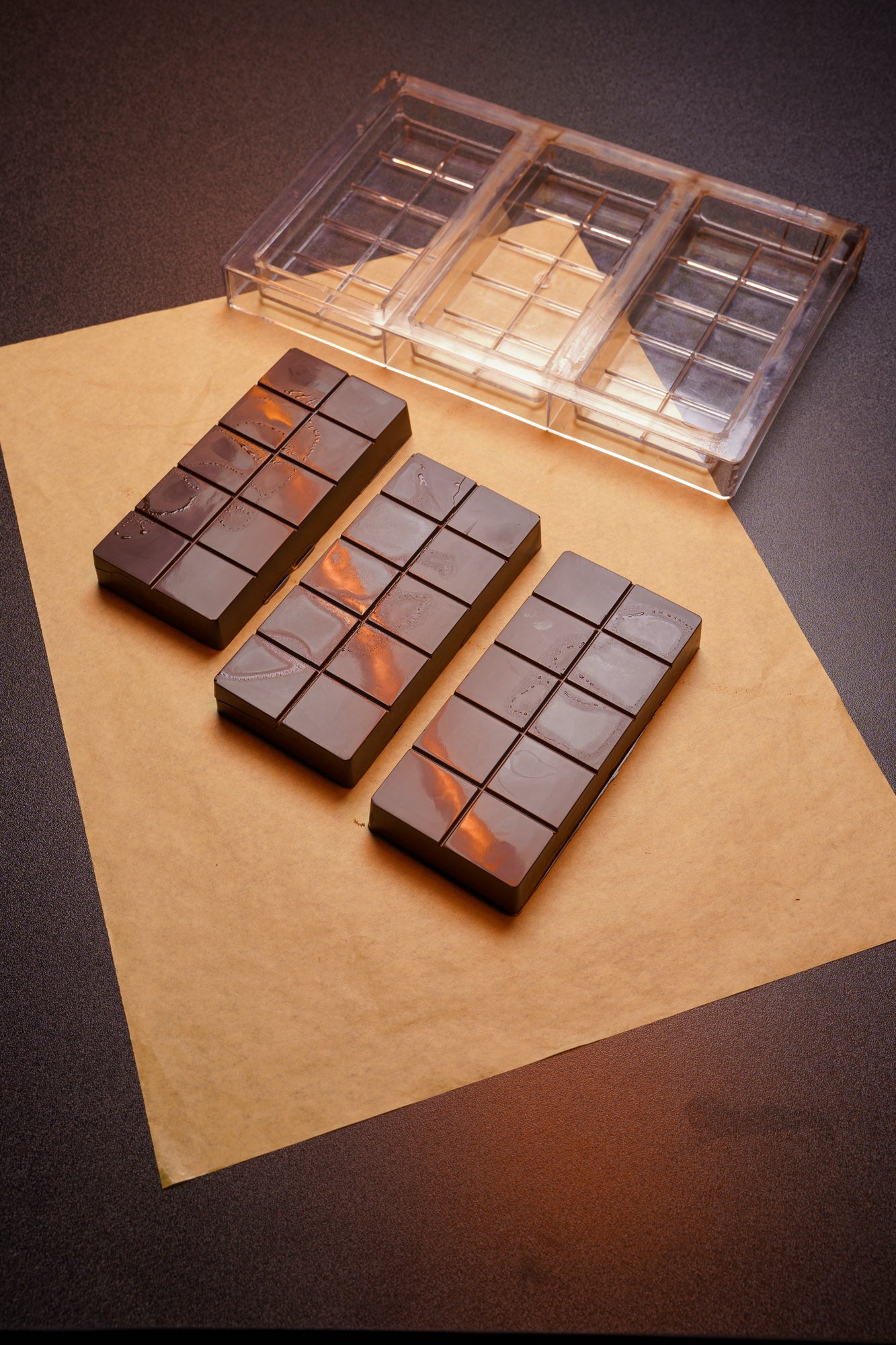
Polycarbonate is the standard rigid mold material for tempered chocolate and deposited candy production for specific reasons. It is dimensionally stable under repeated thermal cycling, rigid enough to support the contraction-and-release mechanism that tempered chocolate relies on for clean demolding, and transparent enough to allow visual quality checks while product is still in the mold. That transparency is not cosmetic. On a production floor running hundreds of molds per shift, the ability to spot air pockets, incomplete fills, or crystallization defects without removing the product saves time and reduces waste.
Not every polycarbonate formulation performs the same way. Some contain fillers or pigments that reduce clarity and can compromise the material's food-contact safety profile. A formulation engineered specifically for food use, with zero unnecessary fillers, delivers the translucency and purity that professional production environments require.
Mold selection decisions are engineering decisions. The specifications that matter most for precision dosing in a US confectionery plant fall into a few critical categories.
Wall thickness is a primary indicator of mold durability and dimensional stability. Thin polycarbonate molds, common in craft and hobby channels, warp after repeated thermal cycling and lose their cavity geometry. A strong, 3.0mm wall thickness (a standard thickness on all stock polycarbonate Bold Maker molds) provides the rigidity needed to maintain consistent cavity volumes across thousands of production cycles. Thicker walls resist the flexing and distortion that degrade dosing accuracy over time.
Cavity volume tolerances determine how precisely your mold controls portion size. Manufacturing tolerances of plus or minus 2.5% of assigned dimensions are a reasonable benchmark for professional-grade confectionery molds. Tighter than that is difficult to maintain at scale; looser than that introduces dosing variability that compounds across large production runs.
Surface finish directly affects both product quality and demolding speed. A proprietary polishing process creates a smooth, high-gloss cavity interior that transfers a mirror finish to tempered chocolate and speeds up release. Scratched, pitted, or matte cavity surfaces cause sticking, slow down production, and degrade the appearance of finished pieces.
Mold layout and cavity spacing affect how many pieces you can produce per sheet pan, which directly impacts throughput. Optimized spacing, made possible by advanced CAD design and CNC machining, can deliver significantly more cavities per mold without sacrificing structural integrity. In some configurations, this means up to 500% more cavities per sheet pan compared to standard mold layouts.

In the United States, polycarbonate resins intended for food contact are regulated under 21 CFR 177.1580, which specifies the conditions under which polycarbonate may be used in producing, manufacturing, packing, processing, preparing, treating, packaging, transporting, or holding food. This regulation covers the base resin, not the finished mold, so buyers need to verify that the entire finished product, including any processing aids, mold-release agents, or surface treatments, meets food-contact requirements.
FDA compliance is a baseline requirement for any serious confectionery mold supplier. What separates professional-grade molds from the rest is independent testing of the finished product and complete traceability of raw materials. Here at Bold Maker, our polycarbonate mold range has been independently tested to ensure compliance, both in raw format and as a finished product (compliance paperwork is always available on request).
FDA compliance is a baseline requirement for any serious confectionery mold supplier.
The regulatory landscape around BPA in food-contact materials is tightening globally. In Europe, Regulation (EU) 2024/3190 now restricts BPA and related bisphenols in food-contact materials, including reusable items like chocolate molds. While US regulation has not yet followed suit at the federal level, the trend is clear. Choosing a mold supplier whose polycarbonate formulation is already BPA-free and independently validated positions your operation ahead of potential regulatory shifts. If you require a BPA-free solution, we have options; contact us for more information.
Most mid-to-large US confectionery plants run depositor equipment. The mold needs to integrate with the depositor's stroke, nozzle spacing, and conveyor dimensions without modification. A mold that does not fit the depositor precisely creates alignment issues that show up as uneven fills, overfills, and wasted product.
Mold design starts with the depositor and works backward to the cavity. The cavity volume, nozzle alignment, row spacing, and overall mold footprint need to be engineered as a system, not assembled from generic components. This is where CAD-driven design and CNC-machined tooling make a measurable difference. Precision-machined molds fit depositor equipment consistently, which means fewer adjustments per production run and less product variability.
For operations producing regulated products where each piece must contain a specific active-ingredient dose, this precision is not optional. A cavity volume that drifts by even a small percentage across a mold sheet multiplies into significant dosing error across a full production run.

The purchase price of a mold is a small fraction of its total cost. The real cost equation includes how many production cycles the mold delivers before it needs replacement, how much downtime it causes through warping or surface deterioration, and how much product waste it generates through inconsistent fills or sticking.
Polycarbonate molds engineered for continuous commercial use, with proper wall thickness, surface finish, and material purity, can deliver an expected lifespan of 8 or more years. That is thousands of production cycles from a single mold. Compare that to thin-wall molds that warp within months of regular use and need frequent replacement, and the cost-per-cycle math becomes very clear.
Mold care practices also extend usable life. Polycarbonate molds can be hand-washed or run through a dishwasher at temperatures up to 140 degrees Fahrenheit. Mildly acidic or alkaline detergents are safe for use. Avoiding abrasive cleaning tools, sharp objects, and high-temperature oven exposure preserves the polished cavity surface that drives both product quality and demolding speed. Proper storage in a clean, dry, sterile environment, with molds stacked flat, prevents surface contamination and physical damage.
Polycarbonate and silicone serve different production needs, and the choice depends on what you are making and how your line operates.
Polycarbonate is the recommended mold type for tempered chocolate production. The rigid mold surface works with the natural contraction of properly tempered chocolate during cooling: as cocoa butter crystallizes into its stable form, the chocolate shrinks slightly and pulls away from the smooth polycarbonate walls, releasing cleanly without tapping, flexing, or release agents. This contraction-and-release mechanism produces the mirror-finish gloss, sharp edges, and clean snap that define professional chocolate.
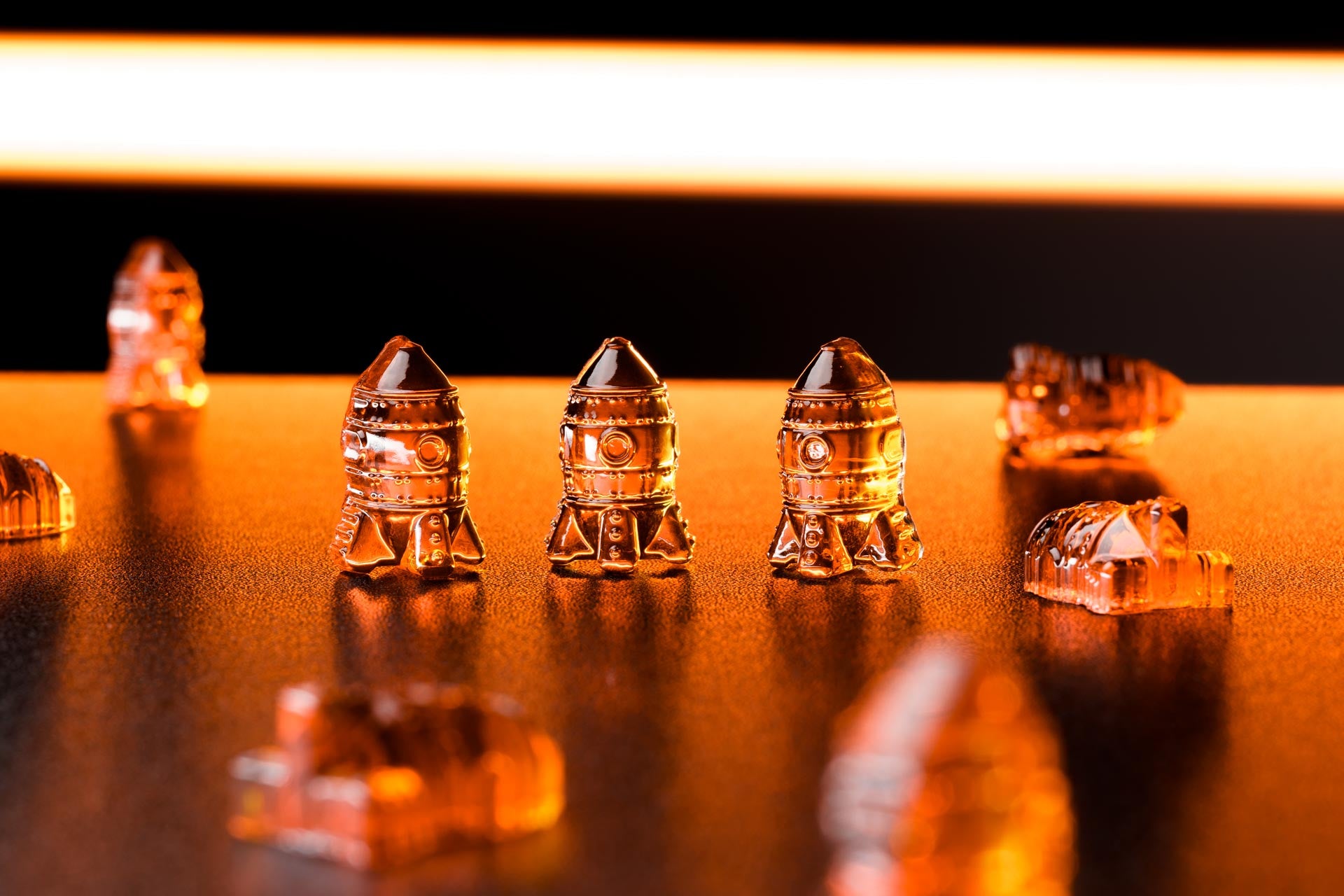
Silicone, by contrast, excels in gummy, candy, and soft confection production, where the product does not undergo the same crystallization process. Platinum silicone molds offer flexibility for demolding, a non-porous closed-cell surface for hygiene, and a temperature range from minus 30 degrees Fahrenheit to 400 degrees Fahrenheit that accommodates everything from frozen applications to hot-pour depositing.
For operations that produce both chocolate and soft confections, maintaining separate mold inventories in the appropriate material for each product line is standard practice. Using silicone molds for tempered chocolate sacrifices the gloss and snap your customers expect. Using polycarbonate for gummies creates unnecessary demolding difficulty.

A mold supplier for precision dosing is a production partner, not a commodity vendor. The evaluation criteria that matter most are engineering capability, material traceability, warranty commitment, and ongoing support.
Engineering capability means the supplier designs molds using advanced CAD programs and manufactures using CNC machining technology, with the ability to create custom cavity geometries to your specifications. It means they can recommend the right mold layout for your depositor, your production volume, and your product dimensions.
Material traceability means every mold comes with documented proof of its polycarbonate source, food-contact compliance, and independent testing results. You should be able to trace the material in your mold back to its origin.
A mold supplier for precision dosing is a production partner, not a commodity vendor.
Warranty commitment reflects the supplier's confidence in their product. A warranty that covers material defects and dimensional stability, such as the Bold Maker Platinum 18-Month Warranty with no-hassle exchanges, signals that the supplier stands behind the mold's performance in a real production environment.
Ongoing support means the supplier's team works with you during your product development cycle, from initial mold selection through production scaling. Confectionery production involves variables that a mold catalog cannot anticipate: recipe changes, depositor upgrades, new product geometries, regulatory updates. A supplier that treats the relationship as a long-term partnership, not a one-time transaction, adds value that shows up in fewer production problems and faster problem resolution.

Choosing the right polycarbonate mold is a production decision with consequences that compound over years of use. The mold that costs a few dollars less per unit but warps in six months, drifts out of tolerance by year two, or cannot produce documentation for a regulatory audit is not a savings. It is a liability. The mold that holds its cavity geometry, integrates with your depositor, meets every food-safety requirement, and comes with a supplier who picks up the phone when you need them is the one that pays for itself, over and over, on every production run.
At Bold Maker, we are more than a supplier, we are the Production Partner. Trust us with your project, and scale your production with us. Get in touch with us, and see how we can help you.
With over a decade of industry experience, we are leaders in mold manufacturing with a specialty in the mainstream candy, chocolate, and cannabis markets.
As proven experts, we design and engineer solutions for some of the biggest confectioners and suppliers on the planet.
If you're looking to create a product that exceeds expectations, contact us today to get started!